
Saber-Toothed Cat
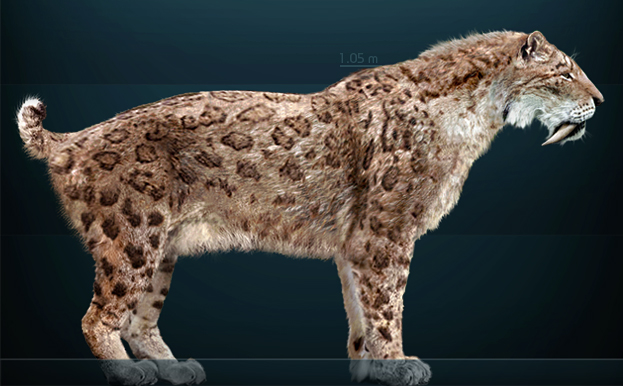
Credit: Sergiodlarosa (Sergio De La Rosa) · CC BY-SA 3.0
The saber-toothed cat was a large, extinct cat famous for its huge, curved front teeth. It lived in North and South America during the last Ice Age. The most well-known kind is called Smilodon. It went extinct about 10,000 years ago, around the same time as the woolly mammoth. Despite its nickname, "saber-toothed tiger," it was not closely related to modern tigers.
Smilodon was built like a heavy, muscular lion. It weighed between 350 and 600 pounds, about twice as much as an African lion. Its legs were short and thick. Its shoulders and chest were packed with muscle. This was not an animal built for long chases. It was built to ambush big prey and hold it down.
The teeth are the reason everyone remembers this animal. A full-grown Smilodon had two curved canine teeth that could grow up to seven inches long, about as long as a dinner knife. The cat could open its jaws almost twice as wide as a lion can. But the teeth were not as strong as they look. Scientists think the cat used its powerful arms to pin prey to the ground first. Then it used the long teeth to make a careful, killing bite to the throat. A sideways twist could have snapped a tooth in half.
What did it hunt? Probably big, slow-moving animals like young mammoths, giant ground sloths, bison, and ancient horses. Some scientists think saber-toothed cats hunted in groups, the way lions do today. Others think they hunted alone. The debate is not settled. One clue comes from fossils that show healed injuries, broken bones, and bad teeth. A cat with a broken jaw could not hunt. Yet some of these injured cats lived for years afterward. That might mean other cats shared food with them.
The best place in the world to see saber-toothed cat fossils is the La Brea Tar Pits in Los Angeles. For tens of thousands of years, sticky natural tar bubbled up from the ground and trapped animals. Predators came to eat the trapped animals and got stuck too. More than 2,000 Smilodon skeletons have been dug out of the tar.
Why did saber-toothed cats go extinct? Scientists are still arguing. The climate was warming fast at the end of the Ice Age. The huge animals they hunted were disappearing. Humans had arrived in the Americas and were hunting many of the same animals. It was probably all of these things working together.
Related
Last updated 2026-04-22