
Sunflower
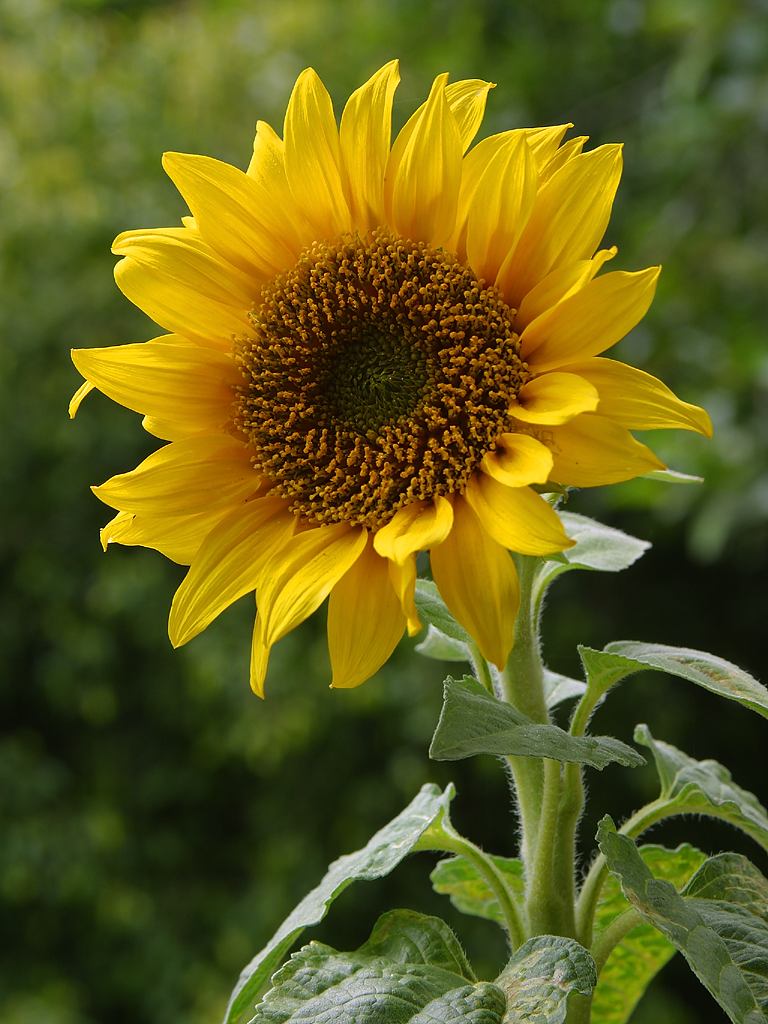
Credit: Wikimedia Commons · Public domain
The sunflower is a tall flowering plant known for its big yellow bloom and dark center. Its scientific name is Helianthus annuus, which comes from Greek words meaning "sun flower." Sunflowers are native to North America. People grew them for food in what is now the United States and Mexico more than 4,000 years ago. Today they grow on farms and in gardens all over the world.
A sunflower has a thick, hairy stem and large rough leaves. Most sunflowers grow between 5 and 12 feet tall in a single summer. The tallest sunflower ever measured grew over 30 feet, taller than a three-story house. The plant lives only one year. It sprouts in spring, blooms in summer, and dies in fall after making its seeds.
The big yellow "flower" is not really one flower at all. It is a flower head made of hundreds of tiny flowers, called florets, packed tightly together. The yellow petals around the edge are ray florets. The dark middle is filled with disk florets, and each one can turn into a seed. A single sunflower head can hold up to 2,000 seeds.
The seeds line up in beautiful curved patterns called spirals. If you count the spirals going one way and then the other, you almost always get two numbers from a famous math pattern called the Fibonacci sequence, like 34 and 55, or 55 and 89. Scientists think this packing pattern lets the plant fit the most seeds into the smallest space.
Young sunflowers do something strange. Before they bloom, their heads slowly turn during the day to follow the sun across the sky. This is called heliotropism. They face east in the morning and west by evening, then swing back overnight. Once the flower opens fully, it stops moving and stays facing east.
Sunflowers are an important crop. People press the seeds to make sunflower oil, which is used for cooking. The seeds are also roasted and eaten as a snack, fed to birds, and ground into flour. Honeybees love sunflowers and gather their pollen to make honey. The plants even help clean dirty soil. After the Chernobyl nuclear accident in 1986, scientists planted sunflowers near the site because their roots can pull some harmful chemicals out of the ground.
The painter Vincent van Gogh loved sunflowers. He painted a famous series of them in the 1880s, and those paintings are now worth millions of dollars.
Last updated 2026-04-25