
Space Station (General)
Credit: NASA · Public domain
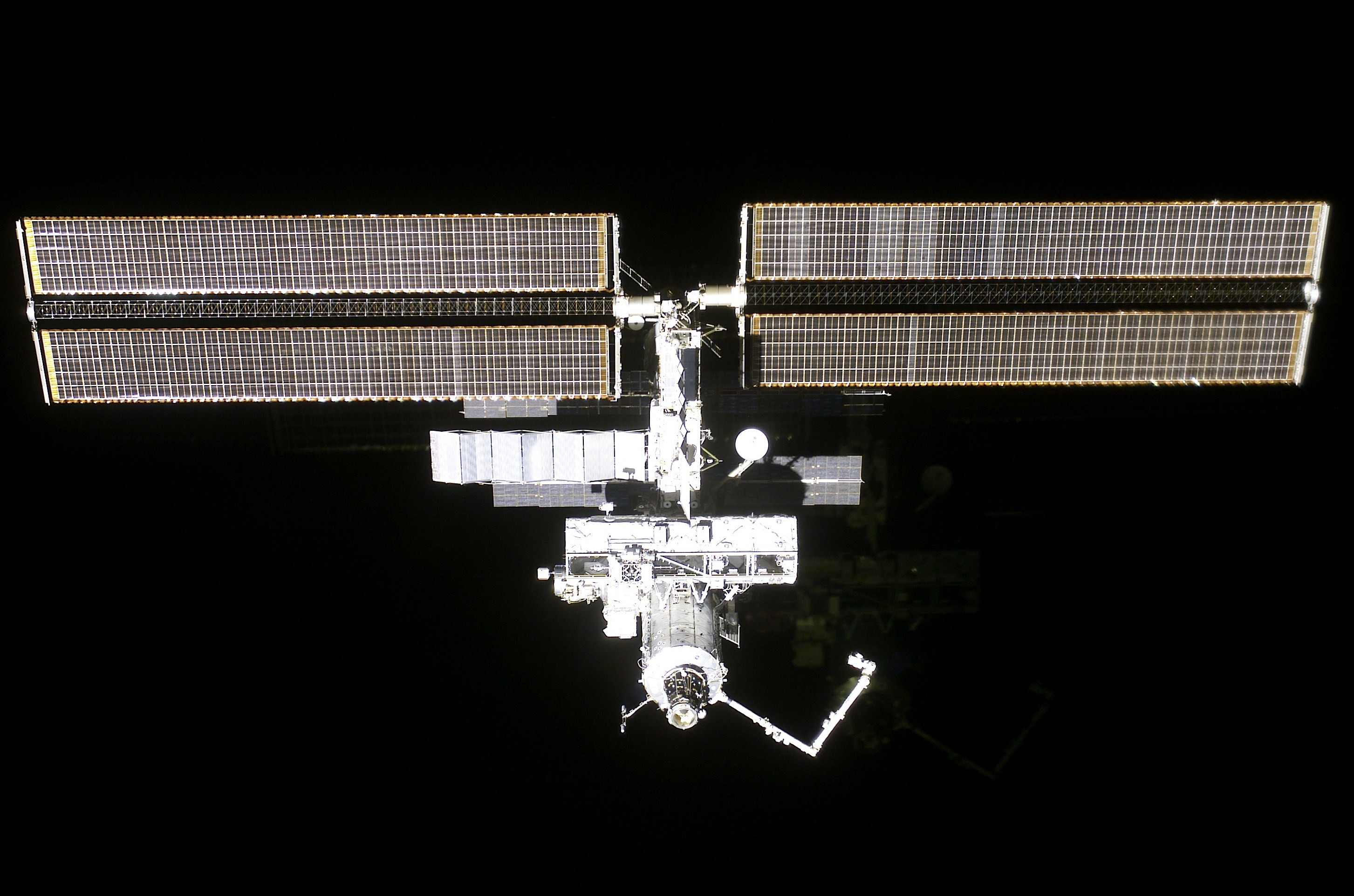
A space station is a large spacecraft that stays in orbit around Earth so that astronauts can live and work inside it. Unlike a rocket or a space capsule, a space station does not travel to another world. It circles Earth again and again, sometimes for many years. Astronauts ride smaller spacecraft to reach it, stay for weeks or months, and then ride back down.
The first space station was launched by the Soviet Union in 1971. It was called Salyut 1. The United States launched its first station, Skylab, in 1973. Since then, several countries have built and used space stations. The most famous one is the International Space Station, often called the ISS. It has been circling Earth since 1998 and has had people living inside it without a break since the year 2000.
A space station orbits about 250 miles above the surface of Earth. That is roughly the distance from New York City to Washington, D.C., but straight up instead of across. At that height, the station falls around the planet at about 17,500 miles per hour. One full trip around Earth takes only 90 minutes.
Inside, the station is packed with labs, sleeping areas, exercise machines, and bathrooms. Astronauts float everywhere because gravity feels almost zero in orbit. They sleep in sleeping bags strapped to the wall so they don't drift into things. They drink through straws from sealed bags. Their food is often dried, with water added before eating.
Why build a space station at all? The main reason is science. In orbit, researchers can study how plants, animals, fire, and liquids behave without normal gravity pulling on them. Astronauts also study their own bodies, because long stays in space cause bones and muscles to weaken. This research helps doctors on Earth and helps plan future trips to the Moon and Mars.
Space stations do not last forever. The air, fuel, and parts on board slowly wear out. When a station reaches the end of its life, ground controllers steer it down into the atmosphere. Most of it burns up, and the rest splashes into a remote part of the Pacific Ocean. Russia's old Mir station came down this way in 2001.
New stations are already being planned. China finished its Tiangong station in 2022. Several private companies are designing smaller stations to replace the ISS after it retires. For the first time in history, living in space is becoming something humans just do.
Related
Last updated 2026-04-22